
Prenatal Yoga vs Prenatal Pilates: Which is right for pregnant people in Dublin 8?
Pregnancy leads to not only physical changes but also emotional ones. If it’s your first pregnancy, these changes may feel unfamiliar or unnerving at first. Many pregnant people seek out safe and supportive movement options to help manage and get comfortable with these changes.
Pilates and Yoga are both popular options during pregnancy, especially because there are specific prenatal class options available. Both are beneficial and as we say here at Breathing Space, Dublin 8, it’s not ‘Yoga vs Pilates’, it’s ‘Yoga AND Pilates’. Whether you choose one or the other (or both) is a personal choice and will depend on your personal preferences, pregnancy stage, and your reasons for seeking out prenatal-specific movement.
At Breathing Space, Dublin 8 we offer Pregnancy Yoga, and Pregnancy-Friendly Mat and Reformer Pilates classes.
Why Prenatal-Specific Exercise Matters?
Pregnancy-specific classes differ from open Yoga or Pilates classes because they take into account how the body changes throughout pregnancy, and offer options to support people through each stage while they maintain a movement practice.
Your body experiences hormonal changes during pregnancy, such as producing more relaxin, which affects joints and their stability. Professional guidance in a prenatal class will prevent you from overstretching your joints during a class.
As your bump grows, your balance, posture and breathing patterns all change. Your Yoga or Pilates practice also needs to adapt to accommodate these changes so you can feel comfortable as you move or rest.
Many people find their energy levels fluctuate across trimesters, with their nervous system working harder to keep body systems steady. Prenatal Yoga and Pilates classes take these fluctuations into account, encouraging you to rest when you need to, or supporting you to move with confidence on days when you have more energy or feel stronger.
Some of the benefits of prenatal specific movement include:
Reduced back and pelvic pain
Better posture and breath awareness
Emotional support and confidence
What is Prenatal Yoga?
Prenatal Yoga (or Pregnancy Yoga) is a gentle yoga practice with plenty of options that is designed for pregnancy. There is an emphasis on breath awareness, mind-body connection, and nervous system regulation.
A class will typically offer varied options for poses (asana) that accommodate different stages of pregnancy, a focus on gentle stretching and mobility, and plenty of time for savasana or a guided relaxation at the end.
This style of class reduces stress, supports relaxation, and can help you prepare for labour and birth. You’ll also be encouraged to connect with your baby which is evidence-based to improve postnatal outcomes for both parent and baby.
How yoga supports the nervous system
Yoga is a body-mind system. If you struggle with a busy mind and anxious thoughts, yoga helps you connect with your physical body, which can help calm your mind. Gentle, mindful movement provides an opportunity to develop awareness of what you experience in your body and mind, creating choice for how you respond. Slowing your breath sends a signal to your body to encourage parasympathetic activation.
What is Prenatal Pilates?
Prenatal Pilates focuses on cultivating strength and stability but with pregnancy-safe adaptations and options. There is an emphasis on developing awareness of the core and pelvic floor, postural alignment, and functional strength.
A class will typically offer controlled, repetitive movements that support daily movement patterns during pregnancy. Regular classes will help support your posture as your body changes, build back and pelvic stability, and develop resilience and strength for pregnancy and postpartum recovery.
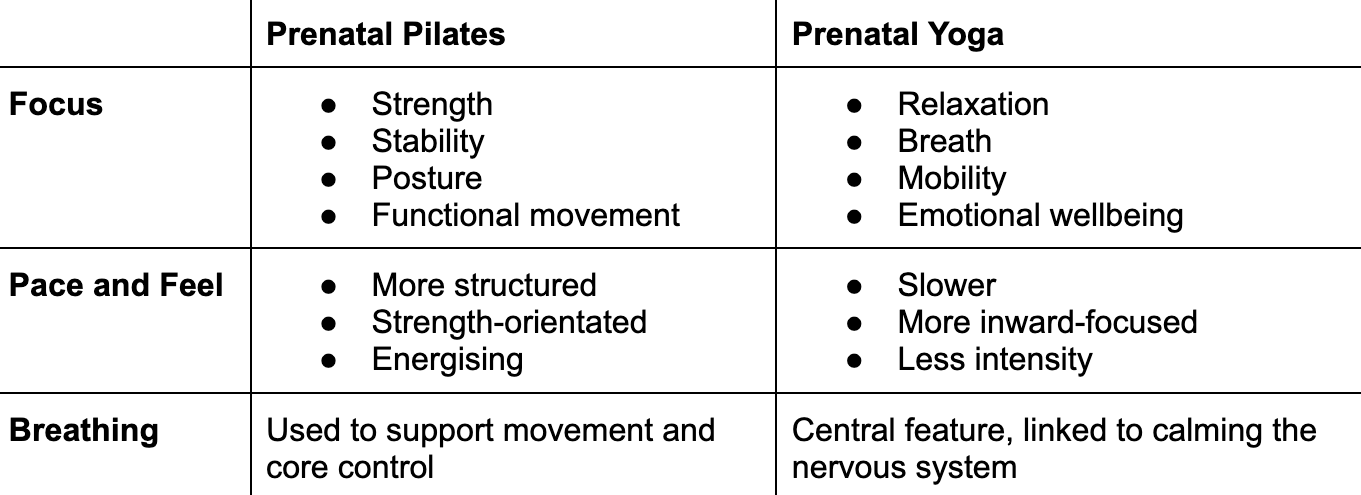
Key Differences: Prenatal Yoga vs Prenatal Pilates
Intentional breathing exercises and breath awareness are a key feature of many yoga classes. A slower inhalation and a longer exhalation support parasympathetic activation and help regulate stress responses in the body.
Which One Might Be Right for You?
A lot of it comes down to personal choice. Perhaps you’ve had a steady Yoga or Pilates practice for some time and want to continue throughout your pregnancy. Or perhaps you feel like you need something different during your pregnancy.
You might prefer prenatal yoga if:
You’re feeling anxious, overwhelmed, or overstimulated
You want to prioritise relaxation and connection
You enjoy slower, more intuitive movement
You’re interested in breathwork for labour preparation
You might prefer prenatal pilates if:
You’re experiencing back pain or postural discomfort
You want to feel strong and supported as your body changes
You enjoy structured, strength-based exercise
You’re thinking about postpartum recovery
Can you do both?
A Breathing Space we encourage you to try both. A combination is the ideal way to get the benefits of each practice, or to get what you need at different stages of your pregnancy. Why not start with alternating weekly between Yoga and Pilates? Or focusing on one modality per month or per trimester?
The most important thing is to listen to your body and trust that you know what is best for you during your pregnancy. If you have any doubts, you are welcome to contact us to speak to Rachel Flynn, who as well as being the founder of Breathing Space, is also a pre- and postnatal Yoga and Pilates teacher, a doula, and leads the Connected Birth workshops at Breathing Spac
What the Research Says?
The HSE and NHS encourage people to continue exercising during pregnancy, and to continue it for as long as you feel comfortable. If you’re new to exercise, then the HSE has advice on how to build up from 15 mins until you feel ready for one or more classes a week. The NHS highlights evidence that active people are less likely to experience problems in later pregnancy and labour.
A review of studies on the effects of practicing Pilates during pregnancy showed an improvement in sleep quality and physical mobility, as well as reduced lumbopelvic pain for those participating in the studies. The studies also indicated that prenatal Pilates supports mental health during pregnancy.
Scientific research shows that pregnancy yoga can reduce stress, anxiety and depression; improve physical discomfort and flexibility; support normal birth outcomes such as shorter labour and increased likelihood of vaginal birth; and reduce stress hormone levels.
Practical Tips Before Starting
Whether you’re new to Yoga or Pilates, or continuing your practice during pregnancy, we recommend the following:
Always consult with your healthcare provider before beginning any new exercise programme during pregnancy
Always inform the teacher or instructor you are pregnant and let them know how many weeks you are
Choose prenatal-specific classes
Ensure the teacher or instructor is properly qualified and insured
Listen to your body and reduce the intensity, or rest, when needed
Avoid comparison - every pregnancy is different
All of the teachers and instructors offering prenatal Yoga and Pilates classes at Breathing Space are qualified and insured to teach pregnant people. Our schedule includes prenatal-specific classes, as well as pregnancy-friendly classes that you are welcome to join. Classes that are suitable during pregnancy are clearly indicated on our website and the MindBody app. Read the full class description if you are not sure from reading the class name.
Conclusion
We’ve said it twice but we’ll say it again. There’s no “better” option when choosing either Pilates or Yoga during pregnancy. There is only what suits you at any particular time. We encourage you to stay curious about exercise and movement during pregnancy, practice self-compassion with movement feels different from before being pregnant, and to avoid comparison.
We hope you’ll join us for Yoga or Pilates during your pregnancy, or share this blog with any pregnant friends in and around Dublin 8. Our prenatal classes are tailored for 2nd and 3rd trimester and grounded in evidence-based practice and mindful movement.
